
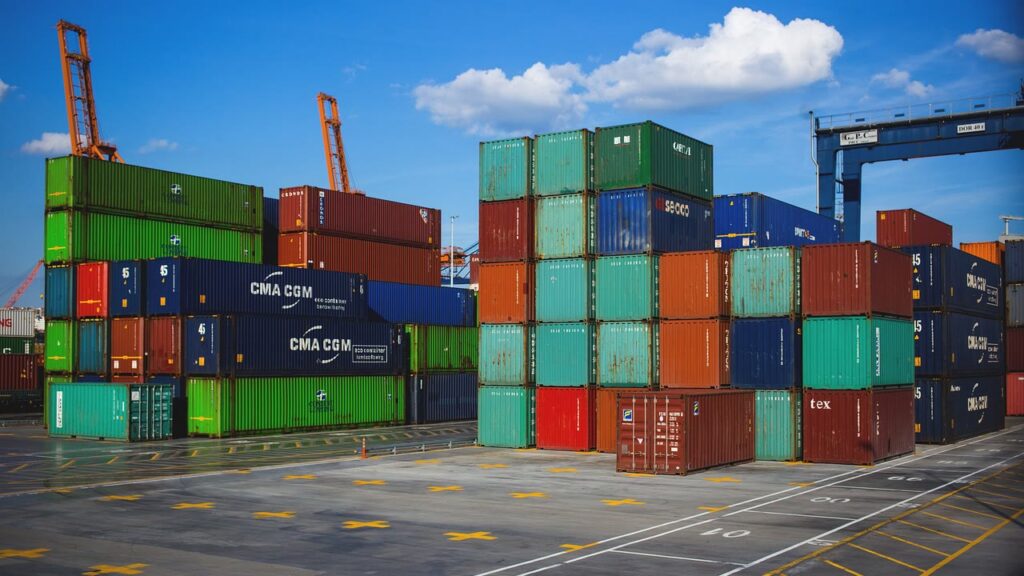
A container arrives full of goods from Asia, is unloaded at the buyer's warehouse, and then often travels back across the sea empty. Nobody ships air for free: the empty trip has a cost, and it ends up in the freight rates. Knowing how this works explains why the same container costs more in one direction than in the other.
Why containers travel empty
- Trade is not balanced. Far more containers leave the big manufacturing countries full than come back to them full: on the Pacific, three times as many containers move from Asia to the United States as the other way.
- Peaks make it worse. In the busy season exports jump, empties pile up where the goods are consumed, and the factories run short of boxes until the empties are brought back.
- After unloading, the importer must return the empty container to the depot the shipping line names. From there it is the line's problem again: find cargo for it nearby, or send it back empty.
The empty flow in figures
| Measure | Figure |
|---|---|
| Empty containers repositioned each month, worldwide | about 4.5 million TEU (2026), against 3 million seven years earlier |
| Empties for every 10 full containers | more than 4 |
| Empties as a share of loaded volumes | about 22 % before the pandemic, 28 % in January 2026 |
| The same share counted in TEU-miles | 32 % before the pandemic, 42 % in January 2026 |
| Share of a shipping line's operating costs | 15 to 20 % |
TEU: one 20-foot container; a 40-foot container counts as two. Measured in TEU-miles, distance counts too, which is why the share is higher.
Who pays
The shipping line pays first: it owns or leases the box and has to bring it back where cargo waits.
Then the cost goes into the rates. On the busy direction, the head-haul, every full container carries part of the cost of the empty one going back. The more unbalanced a trade, the larger that part.
Some lines show it as a separate charge, an empty container repositioning or container imbalance surcharge: the average repositioning cost of a trade lane, spread over each box. It can apply to one size or type only, for example 40-foot high cubes or reefers.
On the quiet direction, the back-haul, the opposite happens: lines offer low rates to fill boxes that would otherwise travel empty.
What it means for importers and exporters in Tunisia
- Importing full containers from Asia, you are on the busy direction: part of the price of your container pays for its return trip.
- Return the empty container to the depot named by the line, within the free days. After that, detention runs: see our guide to demurrage and detention.
- Exporting, you may be on the quiet direction of a trade: ask for a rate, because lines want to fill boxes that are already here.
- Lines sometimes send an empty box straight from an importer to a nearby exporter, so it does not travel empty at all. That is the line's decision, but it is worth asking.
What to check in your quote
- Whether an imbalance or repositioning surcharge applies, and whether it is already in the price.
- Which depot the empty container goes back to, and how many free days you have.
- Whether the rate for the return direction is lower: it often is.
How each line of a freight price is built is explained in how a freight quote is built, and what a container from China to Tunisia really costs in what makes up the price of a container from China to Tunisia.
In short
- Trade is unbalanced, so many containers go back empty.
- Worldwide there are more than 4 empties for every 10 full containers.
- The busy direction pays for the empty trip back, in the rate or as a surcharge.
- Return empties on time, and ask for rates in the quiet direction.
Importing or exporting by container? Contact us: we compare the lines, show every surcharge in one price, and tell you where and when the empty goes back.
Sources
- The Loadstar: Trade imbalances drive surge in empty containers (Sea-Intelligence, 2026)
- Kuehne+Nagel / Lloyd's List: Equipment repositioning hits carrier costs (2024)
- The Geography of Transport Systems: Containerized cargo flows along major trade routes
- Marine Insight: How is management of empty shipping containers carried out?
Read on 22 November 2026. The figures are worldwide averages; the rate for your container depends on the line, the trade and the season.
Planning a shipment? Request a quote with every fee included upfront, or talk to our team in Tunisia: +216 70 295 255, info@kyranislogistics.com.


Comments
Ask a question or share your experience.
No comments yet. Be the first to ask a question.