
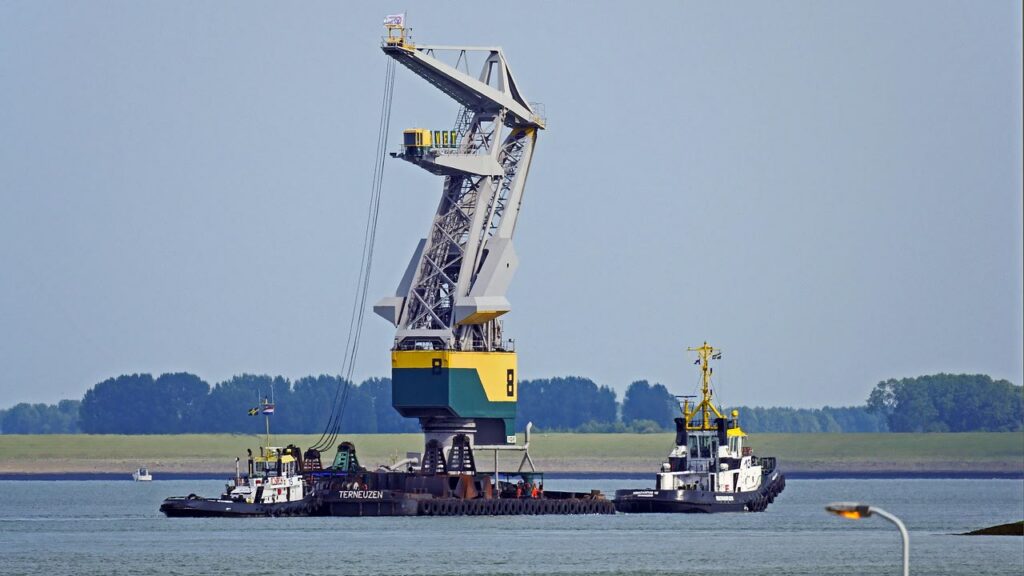
A machine, a boat, a coil of steel or a long structure often does not fit through the doors of a normal container, or is too heavy for it. Carriers have special containers for this cargo: some without a roof, some without side walls. The goods still travel on a container ship, with container cranes, which is usually simpler and cheaper than breakbulk.
Four special containers
| Container | How it is loaded | Good for |
|---|---|---|
| Open top | From above by crane, or through the door; no loading from the side. A tarpaulin covers the cargo, and the beam above the door swings out. | Tall cargo: machines, cable drums, cargo that must be lifted in. |
| Hard top | Like the open top, with a steel roof a forklift can lift off; loading from the roof or the door. | Tall or heavy cargo that must stay dry and locked. |
| Flat rack | A floor with end walls and no sides: from the side by heavy forklift, or from above by crane. | Heavy, wide or long cargo: vehicles, machinery, steel, boats. |
| Platform | A 40-foot flat rack with its end walls folded down. | Very long loads, stowed on deck. |
All four come in the usual 20 and 40-foot lengths, so that they fit standard trailers and port equipment; more choice is in our guide to container types.
The flat rack in figures
- Hapag-Lloyd's 40-foot high cube flat rack, as an example: about 11.65 m long and 2.22 m wide between the corner posts, with a payload of 44 to 54 tonnes depending on the model.
- The lashing points along the side beams and the end walls take 5 tonnes each.
- The cargo is placed in the middle, so that the weight is spread, and lashed to the floor's rings.
- When the cargo is too long or too wide for one, two or more flat racks are joined to carry it.
Figures differ from one carrier and one model to another: the carrier's own specification decides.
In gauge or out of gauge
Cargo is in gauge when it stays within the size of the flat rack or open top. It needs the special container, but takes no more room on the ship.
Cargo is out of gauge when it sticks out in length, width or height. Then no container can go on top of it or right beside it: the space lost is called lost slots, and the carrier charges for it.
The ship is planned slot by slot from the sizes you declare. If the cargo turns out bigger, it may have to be stowed elsewhere and other boxes moved.
Measure everything, then declare it
- Measure the cargo as it will travel: with its crate, its supports, the dunnage and the lashing equipment that sticks out.
- Say whether the end walls of the flat rack will be up or down.
- Give the real weight, packaging included.
- Lash it so it cannot move at sea: cargo that shifts changes its own size.
Cargo that arrives at the terminal bigger or heavier than declared can be refused, or charged extra freight and handling; Maersk adds a misdeclaration fee of 500 US dollars.
What to send when you book
- What the goods are, and how they are packed.
- Length, width and height, in centimetres.
- The total weight, packaging included.
- How many lifting and lashing points there are, and where.
- Photos or drawings, and where the cargo can rest.
With this, the carrier can choose the container and plan the slot, and we can plan the truck and the crane to the port. The rest of a good request is in how to request a freight quote.
Too big even for a flat rack?
A load that would need several flat racks, or that is too heavy for any, can travel as breakbulk instead, lifted on board piece by piece. From Tunisia, see our breakbulk shipping page.
Common mistakes
- Measuring the machine but not its crate, its supports or its lashings.
- Booking an open top for cargo that must be loaded from the side.
- Declaring the cargo in gauge when a part sticks out by a few centimetres.
- Forgetting the lifting points, so that nobody knows where the crane may lift.
- Leaving the truck to the port until the last day: big cargo needs a suitable trailer and a planned route.
In short
- Too tall: open top or hard top. Too wide, too long or too heavy: flat rack, or platform on deck.
- In gauge takes no extra room; out of gauge costs lost slots.
- Declare the sizes as the cargo will travel, lashings included.
- Send dimensions, weight, lifting points and photos when you book.
Shipping a machine or a structure that does not fit a normal box? Contact us: we check the sizes with the carrier, book the right container and plan the road to the port.
Sources
- Hapag-Lloyd: Think big, special cargo (brochure)
- Maersk: Out of gauge cargo, a quick guide
- Marine Insight: What is OOG or out of gauge cargo?
Read on 22 November 2026. The figures are a carrier's examples: the right container for your cargo is the one the carrier confirms for that booking.
Planning a shipment? Request a quote with every fee included upfront, or talk to our team in Tunisia: +216 70 295 255, info@kyranislogistics.com.


Comments
Ask a question or share your experience.
No comments yet. Be the first to ask a question.